

Neo-Industrial Companies Are Inference Machines
World Models do not become industries. Only Neo-Industrial companies can close the inference loop between intelligence and industrial reality.


Foreword
This essay is the third in a series on the architecture of Neo-Industrial Companies, and is co-written with my Arsenale Co-Founder, Matteo Zanotto, the brain and the force behind all things AI at Arsenale.
In the series, “The Neo-Industrial Age: What Comes After Deep Tech”, defined the new industrial form and its ten pillars. “The Generative Phenotype” established the ontological difference between organizations that adapt and organizations that generate, and introduced the Digital Original as the substrate where organizational intelligence accumulates and compounds.
This essay names what that intelligence actually is, in technical terms. The Neo-Industrial Company is, in the most precise sense available, an inference machine: an organization architected to close the loop between its model of the world and the world itself, by either updating the model or acting on the world to make the model true. This is what neuroscientists and part of the AI research community call active inference. As we will argue, the same architecture, whether or not the term is used, is also being implicitly rebuilt by some of the most ambitious projects on the AI frontier.
Why Demos Are Not Industries
The leap from research-grade to production-grade AI is not a matter of more compute or better models. It is a matter of becoming the kind of organisation that generates, in operation, the data its model needs to keep being right.
One of the most striking features of today's AI conversation is the gap between what gets demonstrated in a lab and what works in the world. A humanoid robot does a backflip in a research video. Another one folds a shirt in a sterile kitchen. A simulator runs a million plant trajectories overnight. None of these is fake, and all of them are real progress. And yet, when we walk into an actual factory, an actual fermentation plant, an actual battery line, we find something else entirely: a slow, grinding, deeply human attempt to make a physical process behave the way the spreadsheet said it would.
A16Z's Oliver Hsu has framed this gap in concrete numbers. With thousands of operations per day, 95 percent reliability means fifty failures requiring human intervention. Ninety-nine percent means ten. Production needs something closer to 99.9 percent, which is one or fewer per day. The leap from research-grade to deployment-grade reliability is not solved by more compute or better models. It is the long tail of failure modes that no benchmark covers, and it is what separates a demo from an industry.
This gap is the most important phenomenon in industrial AI today, and the public conversation is not yet looking at it directly. A demo is a controlled experiment. An industrial endeavour is an open one. In the controlled experiment, the system perceives, predicts, and acts inside boundaries chosen to make model training tractable. In the open one, the system has to keep perceiving, predicting, and acting under conditions that nobody chose, that drift over time, and that contain edge cases the lab never saw. The two environments are not at different points on the same curve. They are governed by different physics of learning.
The technical reason this gap exists is well-known. It is the distributional shift between training and deployment conditions. A self-driving car trained on Palo Alto streets does not entirely generalise to roads in Italy. A robot trained in a research lab fails on a factory floor with conditions it never experienced in the lab. This is the limiting factor in every model deployed into the open world.
The architectural reason, which this essay is concerned with, operates at a deeper level. Closing the gap requires the organization itself to become a data generation machine: one that produces, in the act of operating, the data its model needs to keep being right. Once we see it that way, the Neo-Industrial Company, the organizational form described across this series, is not a metaphor or a strategic aspiration. It is, in technical terms, an inference machine powered by the data it generates.
“Closing the gap requires the organisation itself to become a data generation machine: one that produces, in the act of operating, the data its model needs to keep being right.”
From this perspective, several things that look like separate strategic choices, the Digital Original, vertical integration, the Calibration Imperative, the production capital stack, the rejection of pure-scaling approaches to AI, resolve into a single architecture. This essay is our attempt to name that architecture, locate it in the broader theoretical conversation, and connect it both to where the AI frontier is going and to what Arsenale, in particular, is now beginning to push past.
From Prediction to Action
Active inference says any persistent system minimises the gap between its model and the world, either by updating the model or by acting on the world. The Neo-Industrial Company is the organisational form of the second kind of system: an inference machine that produces industrial reality rather than observing it.
Over the last two decades, modern neuroscience has converged on a striking model of how the brain works: at its core, it is a prediction machine. Rather than passively absorbing sensory input and constructing a picture of the world, the brain constantly generates predictions about what it expects to perceive, and then directs attention to the gaps between prediction and reality. The framework is known as predictive coding, and it has been developed most comprehensively by Karl Friston. It is now one of the most influential theories in cognitive science.
The core insight is that perception is not bottom-up assembly from sensory data. It is top-down testing of hypotheses against sensory data. A familiar illustration: when we walk into our own living room, we do not really "see" most of it. The brain predicts what is there based on memory and fills in the expected details automatically. What we consciously perceive are the prediction errors, the deviations from what we expected. This is why we instantly notice if someone has moved a piece of furniture, but might not register gradual changes in paint colour. Surprise, not stimulation, is what the brain attends to.
Through this lens, the Digital Original introduced in The Generative Phenotype takes on a more precise meaning. It is not a passive simulation of the plant. It is the company's predictive model, its learned expectations about how operational reality should behave. The physical plant is the Real Twin of this generative model, not the other way around. When the plant runs, the intelligent approach is not to capture all data uniformly. It is to measure the deviations from what the Digital Original predicts. Expected states confirm what the organization already knows, and can be sampled lightly. Unexpected states, the prediction errors, deserve high-fidelity attention. The organization learns by accumulating surprise, not data.
“The organisation learns by accumulating surprise, not data.”
Predictive coding addresses the perceptual half of the picture. The other half, and the one that completes the frame for Neo-Industrial Companies, is what Friston calls active inference.
Active inference makes a stronger claim than predictive coding alone. It says that any system that persists over time, whether an organism, a brain, or a company, does so by minimizing the gap between its internal model of the world and the evidence the world feeds back. There are only two ways to close that gap. The system can update the model to fit the evidence, which is perception and learning. Or it can act on the world to produce evidence that fits the model, which is action. Action and perception, in this frame, are not unrelated processes. They are two expressions of the same operation: inference. The system is continuously asking, "given what I believe about the world, what should I do next to test, refine, or confirm that belief?"
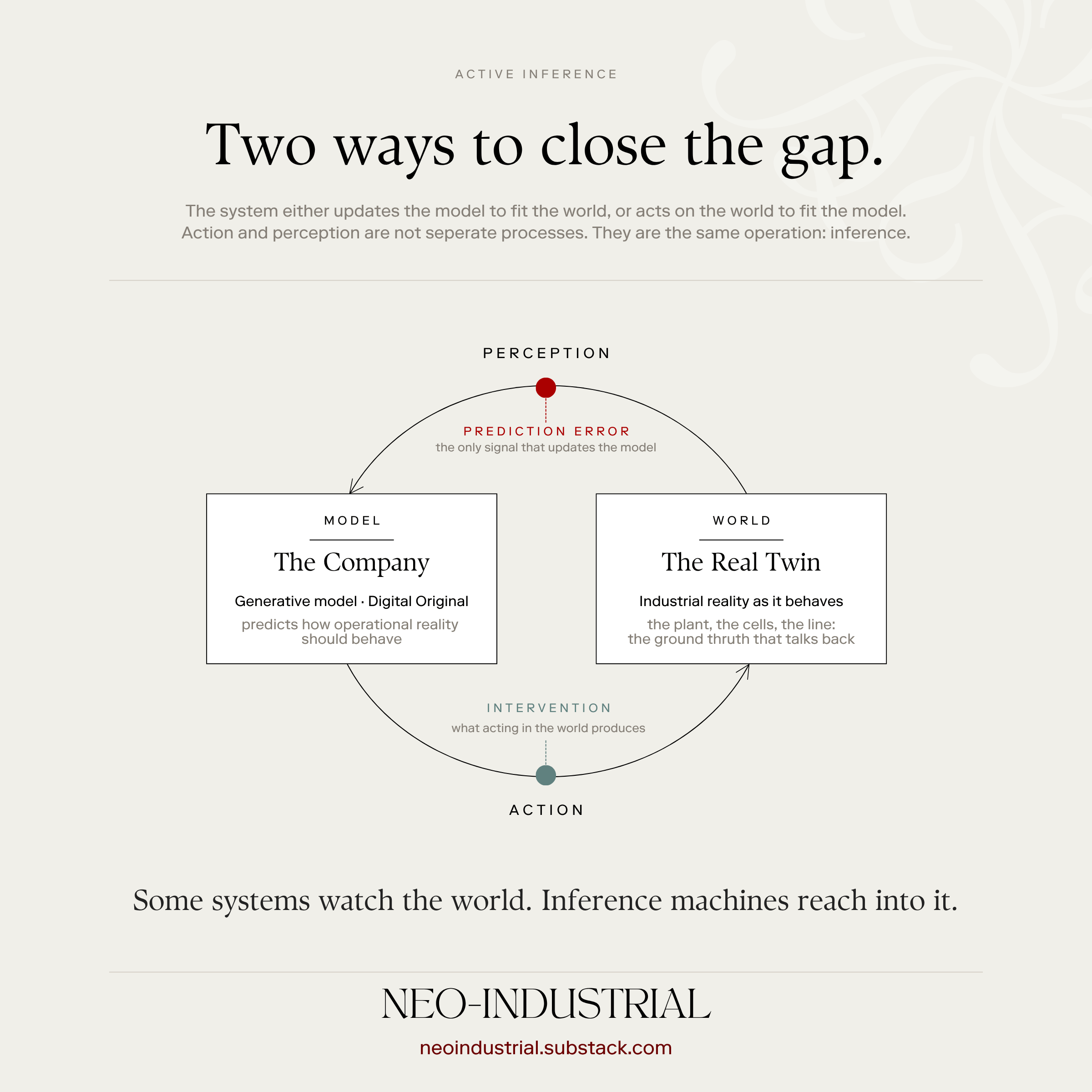
The distinction between these two ways of closing the gap is fundamental, and a contrast makes it concrete. A weather forecasting model is an extraordinary inference engine, but only in one direction. It updates its expectations against satellite data, and it gets better over time, but it does not change the weather. A bioreactor running a precision fermentation process at industrial scale is something else entirely. It predicts what should happen, but it also acts to achieve the predicted outcome, modulating feed rates, adjusting temperature, and intervening on the emergent dynamics. It closes the loop between model and world by reaching into the world1.
The Neo-Industrial Company is the organizational form of that second kind of system. It is not a lab that observes industrial reality. It is an inference machine that produces it.
The DBTL Cycle Is the Inference Loop
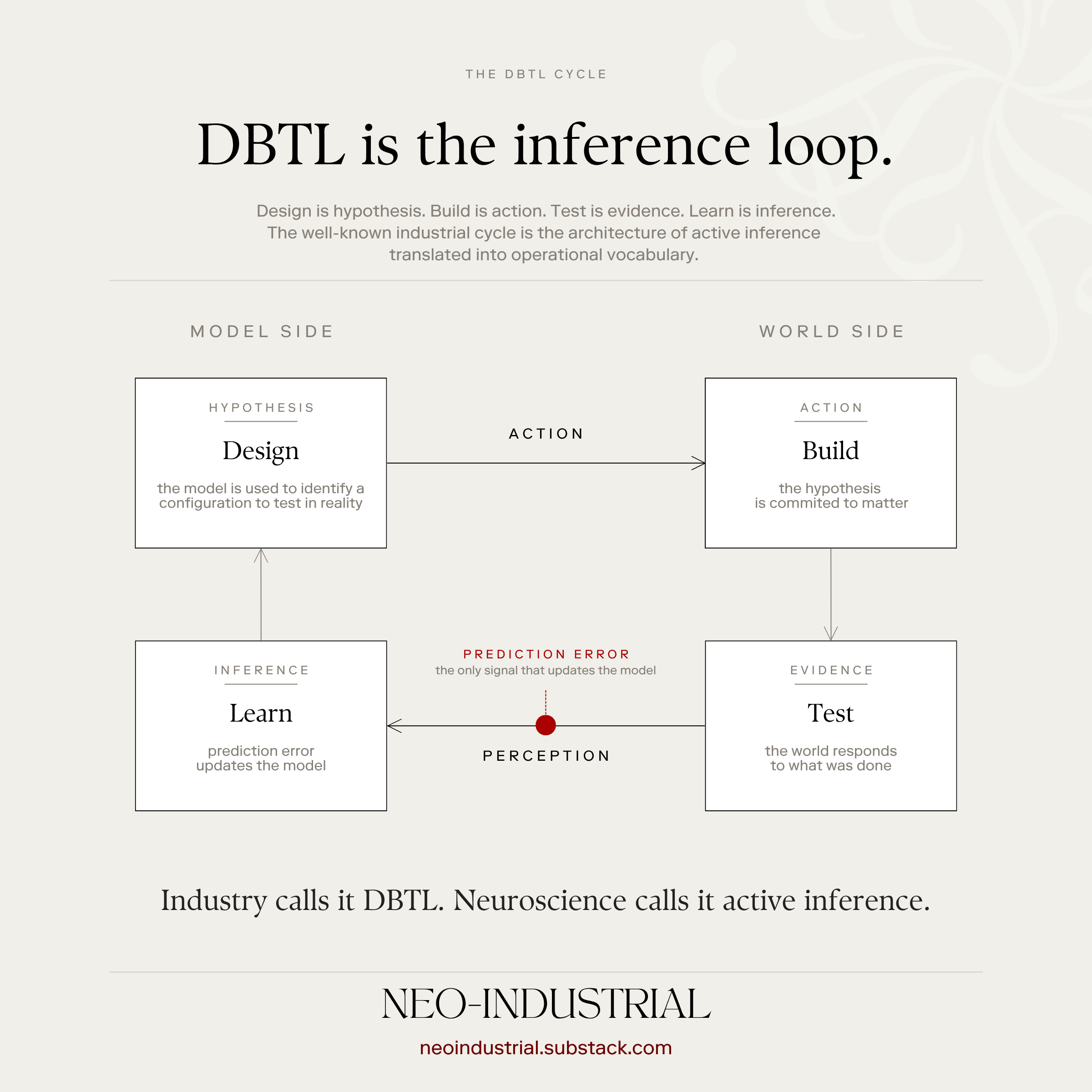
The Design-Build-Test-Learn cycle is, almost line for line, active inference translated into industrial vocabulary: hypothesis, action, evidence, update. The mapping explains why incumbents and the deep tech generation fail in distinct, structurally specific ways.
The Design-Build-Test-Learn cycle has been the conceptual backbone of every essay in this series. It is also, almost line-for-line, the active inference loop translated into industrial vocabulary, and seeing the correspondence is what makes the framework click.
Design is hypothesis formation. The organization, equipped with a generative model (the Digital Original), proposes a configuration of physical reality that should produce a desired outcome. Build is the action that commits the hypothesis to matter: a reactor is constructed, a strain is engineered, a process is set up. Test is the evidence-gathering step, the sensor data, the yields, the analytical readings, the world responding to what was done to it. Learn is the inference itself. The gap between what the model predicted and what the world produced becomes prediction error, and the organization either updates the model, adjusts the next action, or, more usually, both.
What makes this mapping more than a clever analogy is what it explains. The incumbent’s DBTL cycle, as argued in The Generative Phenotype, is not merely slow. It is epistemically constrained. When something unexpected happens on the line, the incumbent’s instinct is to treat it as a defect to be smoothed over, rather than as a clue about how its model of the process is wrong. In active inference terms, this is a system that has decided, structurally, to ignore its own surprise, its “out-of-distribution samples”. The active inference framework describes this pattern directly. A system that suppresses prediction error trades short-term stability for the capacity to learn over time. It hardens its world model against the world. The world catches up with it eventually.
This might seem like fairly dense theory, but the most concrete validation of the active inference framework we have come across recently comes from the industrial world, and from outside neuroscience entirely. In Many Small Steps for Robot, One Giant Leap for Mankind, Packy McCormick and Evan Beard of Standard Bots argue, with operational data and against the prevailing venture orthodoxy, that progress in robotics will not come from a single architectural breakthrough that suddenly makes general physical intelligence appear. It will come, in their words, from “climbing the gradient of variability”, one deployment at a time. The reason is that robotics is not bottlenecked on architectures. The architectures, world models, vision-language-action models, and transformer-based imitation learning largely exist. Robotics is bottlenecked on data, and not just any data. It needs data generated by your specific robot, doing your specific task, in your specific environment, with the actual forces and torques and contact dynamics that video and simulation cannot capture. The data, in other words, prevents your environment from being out-of-distribution for the robot’s underlying models.
The industrial implication is precisely the active inference one. You cannot reach a useful inference loop by perception alone, no matter how large your model or how clever your simulator. You have to act in the world. The most valuable signal is not the data that confirms what your model already predicted. It is the intervention data at the moment of failure, the prediction error that the lab could not have generated. Standard Bots' commercial logic, getting paid to deploy real arms in real factories, learning from where they fail, folding that learning back into the next deployment, is the active inference loop made into a business model.
“The most valuable signal is not the data that confirms what your model already predicted. It is the intervention data at the moment of failure, the prediction error that the lab could not have generated.”
The same architecture, in a completely different domain, is the case Packy McCormick and Pratap Ranade make for Arena Physica in Electromagnetism Secretly Runs the World (Yes, in case you didn’t notice, Massimo is a big fan of McCormick’s work, and McCormick has been a major source of inspiration for him). Arena Physica has built a foundation model for electromagnetic physics, a Large Field Model that learns the relationship between geometries and the electromagnetic fields they produce. The model becomes the generative substrate. A generator proposes candidate shapes, an evaluator scores them in milliseconds rather than the hours a traditional Maxwell solver requires, the best candidates are then fabricated as silicon, and the real-world measurements feed back into training. The system runs the loop “generate, evaluate, learn, repeat”. That is the active inference loop, named almost identically by people who arrived at it from electromagnetic engineering rather than from theoretical neuroscience. The convergence across robotics, electromagnetic design, and biology (Arsenale) is the strongest possible signal that the architecture is general. Inference machines are not a robotics phenomenon or a synthetic biology phenomenon. They are the form that any organization committed to industrial intelligence is being pulled toward.
Which means, by extension, that the Neo-Industrial Company’s DBTL cycle is fast active inference. The incumbent’s is degraded active inference. And the deep tech company that mastered discovery but failed at industrial transfer is the most specific failure of all: an inference machine whose internal world model worked beautifully under lab conditions, but did not transfer when the operating environment turned out to be different.
Three Failure Modes, One Theory
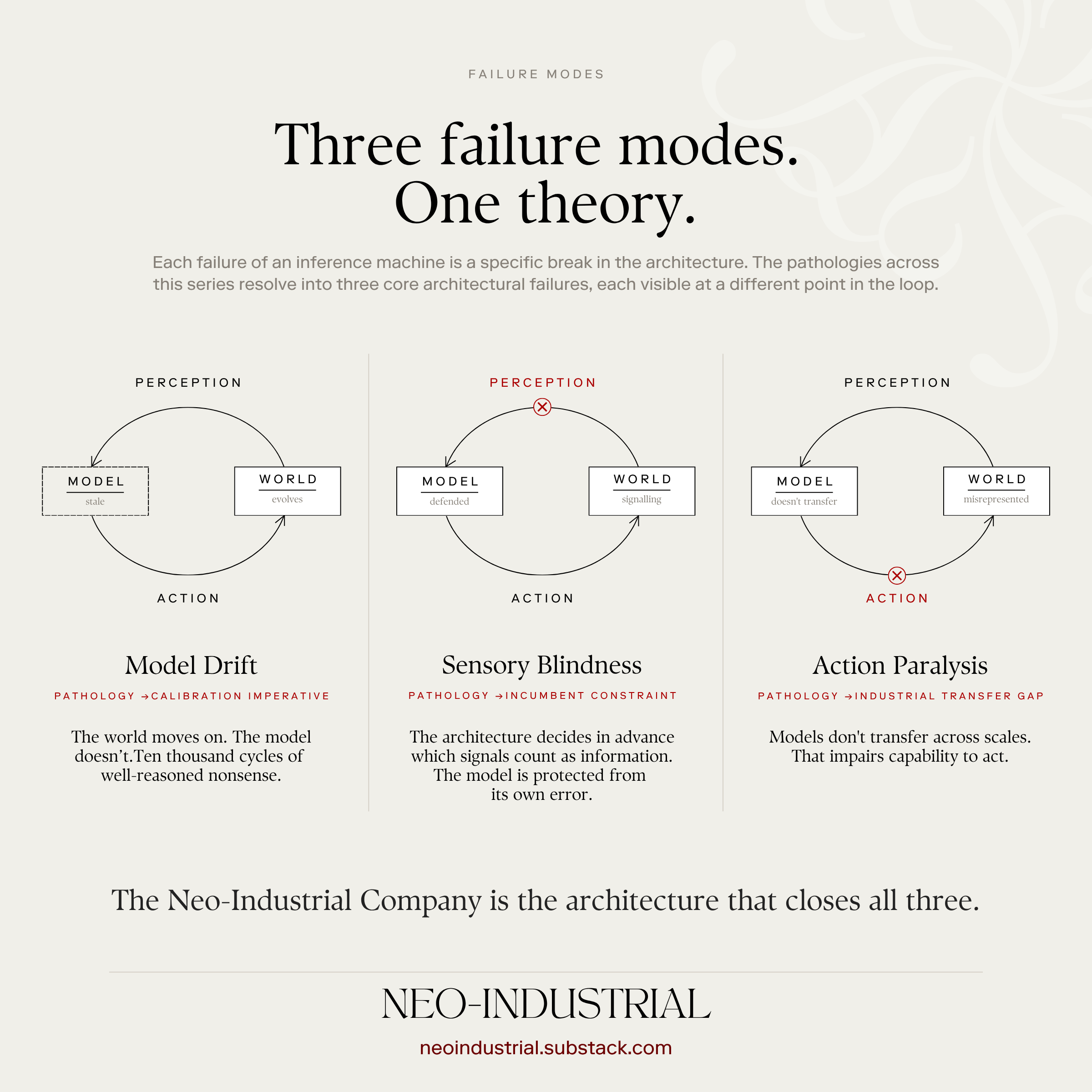
Three failure modes fall out of the architecture, model drift, sensory blindness, and action paralysis, and each one corresponds to a pathology we have named elsewhere in this series. When the architecture is incomplete, they do not merely coexist: they compound.
One of the things active inference offers, beyond reframing the DBTL cycle, is a precise vocabulary for organizational pathology. Three failure modes2 fall out of the architecture, and each one maps onto a pathology already named elsewhere in this series.
The first failure mode is model drift. The generative model is not retrained often enough against the data the operating system is generating. The real process shifts over time, the model does not follow, and the internal representation is allowed to move far from reality before any correction occurs. This is the Calibration Imperative pathology. A Digital Original that is not anchored to ground truth, through first principles, bench-scale data, pilot-scale validation, and the operating Real Twin, becomes a beautifully self-consistent fiction. Ten thousand cycles of well-reasoned nonsense, arrived at faster.
A Digital Original that is not anchored to ground truth, through first principles, bench-scale data, pilot-scale validation, and the operating Real Twin, becomes a beautifully self-consistent fiction.
The second failure mode is sensory blindness. The system can act, but it cannot let evidence update its model. This is the epistemic constraint that defines incumbent innovation. The DBTL cycle runs, the data flows in, but the architecture has decided in advance which signals count as information and which count as noise. The model is protected from its own error. This produces companies that are extraordinarily good at refining what they already know, and structurally incapable of learning what they do not.
The third failure mode is action paralysis. The system perceives accurately, learns continuously, and updates its model with rigor, but not across all the domains that are relevant. As a result, predictions do not transfer across scales, and neither do actions. This is the industrial transfer gap that has defined a generation of failed deep tech ventures. We can assume that companies like Zymergen and Northvolt had inference machines that worked beautifully at lab and pilot scale, but they could not extend their action policies into industrial reality.
The Generative Phenotype is the organizational form that solves all three pathologies in a single architecture. It has a generative model (the Digital Original), it lets prediction error update the model (learning), and it can act on its predictions at industrial scale (the ten pillars, particularly Design for Manufacturing from Day One and the Production Capital Stack). What seemed to be a list of features spread across essays is, in reality, a system. Active inference is what makes the system a system. Where the architecture is incomplete, as Hsu has documented in detail for industrial AI, these failure modes do not merely coexist. They compound.
The Loop That Balances Itself
Intelligent systems balance exploration, learning what the model does not yet know, against exploitation, acting on what it does. Incumbents lock onto exploitation; the deep tech generation locked onto exploration; the Neo-Industrial Company is built to hold the two in dynamic balance.
The three compounding failure modes name what an inference machine has to avoid. The harder question is what it has to do right, and the answer is more subtle than minimizing prediction error in the moment.
Active inference, in its mathematical form, says something more interesting than “minimise the gap between model and reality right now”. It says an intelligent system minimises expected prediction error over the futures it is choosing between. That objective splits into two parts that pull in opposite directions. One part rewards actions that reduce uncertainty about the world, learning what the model does not yet know. This is exploration. The other part rewards actions that achieve good outcomes given what the model already knows. This is exploitation. An intelligent system shifts continuously between the two, exploring more when the model is uncertain, exploiting more when the model is confident, with the balance shifting moment by moment as the world changes and the model updates.
James March named this tension in 1991, and it has been the central problem of organizational learning ever since. Active inference gives the same tension a mathematical form. Neo-Industrial Companies are the organizational form built to hold the two sides in dynamic balance, rather than collapsing onto one.
Through this lens, the failure modes sharpen. The incumbent corporation is locked on the exploitation side. Decades of optimization have eliminated the slack, modularity, and option value that exploration requires. The architecture cannot afford to explore, because every part of it has been tuned to extract from what is already known. The deep tech generation that defined the last decade, by contrast, was locked on the exploration side. Discovery worked beautifully. Exploitation at industrial scale never developed, because the organizational architecture for converting exploration into deployment was never built. Both are pathologies, and both are architectural rather than strategic. You cannot exhort an incumbent to be more exploratory, or a deep tech company to be more deployable. The architecture decides for them.
The Neo-Industrial Company is built to hold the balance dynamically. The Digital Original is the substrate that makes this possible, because it makes exploration cheap. Tens of thousands of variants can be tested in silico at the cost of compute rather than steel. The Real Twin then executes exploitations that have been validated in advance, at industrial scale and at industrial economics. The DBTL cycle is the loop that arbitrates. Each iteration shifts effort between exploring new design space (when the model is uncertain) and exploiting validated regions (when the model is confident). Learning is what keeps the balance from drifting. Without it, the company tilts toward exploitation of an increasingly fictional model, which is the failure mode we named earlier as model drift.
The Arena Physica essay sharpens one operational point about how this balance actually works. “When you’re searching for good designs,” the authors write, “speed and direction matter more than precision.” The neural surrogate that approximates Maxwell’s equations is, by design, less accurate than the precise solver it replaces. By Arena Physica’s own benchmarks, it is also up to eighteen thousand times faster. Approximate but fast inference is what allows the system to explore design spaces a precise simulator could never have searched. Exploration, in active inference terms, requires that the cost of testing a hypothesis fall below the value of resolving uncertainty about it. The Digital Original is the substrate that makes that condition obtain. It is not necessarily more accurate than the slow physics it replaces, but it is fast enough to make exploration cheap. This is why the explore/exploit balance, in Neo-Industrial architectures, can shift continuously, rather than being trapped at one pole.
This is the property that incumbents cannot replicate by spending more on R&D, and that deep tech companies could not produce by raising more capital. Both interventions assume the explore/exploit trade-off is a resource allocation problem. Active inference reveals it as an architectural property, a function of how the inference loop is wired, where the prediction errors flow, and what kind of model the system is permitted to update. The Neo-Industrial Company is the organizational form that wires the loop correctly. The balance is not chosen each quarter. It is the system’s natural operating mode. A future essay in this series will develop the explore/exploit dynamic in its own right (an issue that has been “plaguing” Massimo since he got exposed to Kauffman’s “adjacent possible”).
“The balance is not chosen each quarter. It is the system’s natural operating mode.”
Vertical Integration Is Calibrated Permeability
An inference machine has a boundary, the channels through which information flows inward and action flows outward. In an immature industrial domain where the protocols do not yet exist, vertical integration is what keeps that boundary calibrated.
Every inference machine has a boundary. Information has to flow inward through the channels the system uses to perceive the world, and action has to flow outward through the channels the system uses to act on it. A boundary that lets information in but cannot project action outward, or one that acts without absorbing what the world feeds back, breaks the inference loop. The system is either watching or pushing, but not learning. In The Generative Phenotype, the property that keeps this boundary functioning was called Calibrated Permeability: the discipline of letting the right information cross in both directions, at the right tempo, without losing coherence.
This concept is also the correct theoretical lens on Packy McCormick’s long-running argument about Vertical Integrators. McCormick has been making the case for several years that the defining companies of the next industrial era will be those that own significant portions of the value chain, where, in his line, the integration is the innovation. Standard Bots is one of the cleanest current examples. They make the arm, the firmware, the motor controller, the data collection tools, the models, and the deployment process, all in-house, because the data flowing back from the field is only worth what it is when it is tightly aligned with the hardware that will use it.
Viewed through active inference, this is not a strategic preference. It is an architectural necessity for any organization trying to operate at the frontier of an immature industrial domain. The reason is that the boundary of an inference machine has to be permeable to the right information. If sensory channels are noisy, mismatched to the generative model, or filtered through partners whose incentives differ from yours, prediction error fails to update the model in useful ways. If action channels are mediated by suppliers operating at different clockspeeds and with different tolerances, the action policy degrades before it touches reality. Vertical integration, in domains where the action-perception loop is still being learned, is how you keep this boundary calibrated. It is what lets the inference loop close.
Arena Physica makes the same architectural point in a completely different industrial domain. The company has integrated everything an inference machine for electromagnetism requires: the rare RF designers who can seed the training data, the Large Field Model that learns from it, the Data Factory that scales the loop, the fabrication line that closes it against silicon, and the agentic stack that orchestrates the whole. The argument is explicit: “you can’t build a foundation model for EM without it,” referring to the Data Factory. The data does not exist in the wild. Almost every training example has to be generated, validated, and fabricated by the company itself. The boundary has to be vertical because the protocols that would allow it to be horizontal do not yet exist. The same logic applies to industrial biology, advanced materials, and any other domain where the action-perception loop is being invented rather than refined.
“The boundary has to be vertical because the protocols that would allow it to be horizontal do not yet exist.”
The two-way permeability point raised in The Generative Phenotype piece, that data and models must flow outward to suppliers and partners as much as they flow inward, is exactly this. In a mature industrial ecosystem, the boundary can include third parties because the protocols and tolerances have been standardized. In an immature one, the protocols are still being invented, and the only way to keep the boundary coherent is to bring it under one roof. McCormick observes that markets cycle between vertical and horizontal modes, going vertical to innovate product, horizontal to scale and reduce cost, on roughly forty- to fifty-year arcs. The Neo-Industrial Age, by every indicator we can see, is firmly in the vertical phase. The horizontal phase, when it comes, will be the one in which Neo-Industrial Companies hand pieces of their inference loops to specialists. We are not there yet, by any means.
Physical AI Needs an Industrial Substrate
Physical AI is active inference applied to physical systems, an architecture that has been there all along. What is new in 2026 is the convergence: perception, world models, action policies, and learning loops finally working at the same time. The Neo-Industrial Company is the organisational form that turns that convergence into industry.
The AI conversation in 2026 has shifted decisively, from models that only process text (language models) to what Jensen Huang and others have called Physical AI. The phrase covers a cluster of related ideas: AI systems that reason about physical reality, that understand causality and dynamics, that can be embedded in robots and factories, that maintain world models rather than just statistical correlations. Yann LeCun's JEPA architecture is built around exactly this conviction, that the path to general intelligence runs through systems that learn predictive world models, not through ever-larger language models. Demis Hassabis has been making the same case from DeepMind, framing the future of AI as the construction of generative world models that can simulate, predict, and intervene. NVIDIA's strategy has reorganized around this premise, from Cosmos as a world-model platform, to Isaac for robotics, to Omniverse as a simulation substrate. Fei-Fei Li's World Labs is building spatial intelligence as the missing layer between perception and action.
What unifies these efforts is something the public discussion has not named clearly enough. Physical AI is, at the architectural level, active inference applied to physical systems. The world model is the generative model. The robot is the agent. The simulation environment is the substrate where prediction error can surface before deployment.
This architecture has, in truth, been there all along. Reinforcement learning has been making structurally similar arguments for decades, and Friston’s active inference is one of several formal languages that capture them. What is genuinely new in 2026 is not the recognition that perception, world models, action policies, and closed learning loops belong together. It is that, until very recently, no single one of those components was working well enough to be wired to the others. Perception was failing, or world models were too brittle, or the action policy was too narrow, or the loop was too slow. Each piece was being patched separately, by separate communities, in different decades. We are now at a point of convergence where enough of the components work to make the reunification possible. The Neo-Industrial Company is the organisational form that does the reunifying3.
Hsu has identified five primitives underpinning the Physical AI stack: learned representations of physical dynamics, architectures for embodied action, simulation and synthetic data as scaling infrastructure, an expanding sensory manifold, and closed-loop agentic systems. Each primitive is something a Neo-Industrial Company depends on, but does not necessarily produce itself. The Digital Original of a fermentation plant could run on the same simulation infrastructure NVIDIA builds for robotics. The sensory stack of an industrial bioreactor benefits from the same expansion of the sensory manifold driving consumer wearables. The Neo-Industrial Company should not be seen as a competitor to the AI frontier. It should be seen as the organizational form that absorbs the frontier's primitives and deploys them into industrial reality.
This matters for the Neo-Industrial argument because it reveals what Physical AI actually needs to become real. A world model in a research lab is still a theoretical exercise. A world model embedded in an industrial system that produces, adjusts, and learns at scale is an industry. The transition from one to the other goes beyond software and becomes an organizational problem, precisely the problem Neo-Industrial Companies are configured to solve. Without an industrial substrate, Physical AI remains a demonstration. With one, it becomes a class of operating systems for the production of matter. The same active inference principles that drive a humanoid robot through a warehouse drive a fermentation line, a battery factory, a fab, a fusion plant. The architecture is the same. What differs is the substrate on which it runs, and the organization capable of running it.
Neo-Industrial Companies are the organizational form that turns Physical AI into a neo-industrial endeavour4. Standard Bots is doing exactly this in robotics, building the inference loop from first principles, deploying it in real factories, getting paid to gather the prediction errors that no lab could have generated. Arena Physica is doing the same thing for electromagnetic design, with the Data Factory feeding a Large Field Model that fabricates and validates its own outputs. Different domain, same architecture. The relationship between Physical AI and the Neo-Industrial Company is, we would argue, structurally similar to the relationship between the integrated circuit and the modern electronics industry. The IC was the technical breakthrough. The semiconductor company was the organizational form that turned the breakthrough into an industry. Neither would have produced the modern world without the other. Physical AI is the technical breakthrough of this decade. The Neo-Industrial Company is the organizational form that converts it into industrial reality. The sooner this connection is named, the sooner the strategic implications become visible.
Beyond Physical AI: Biological AI
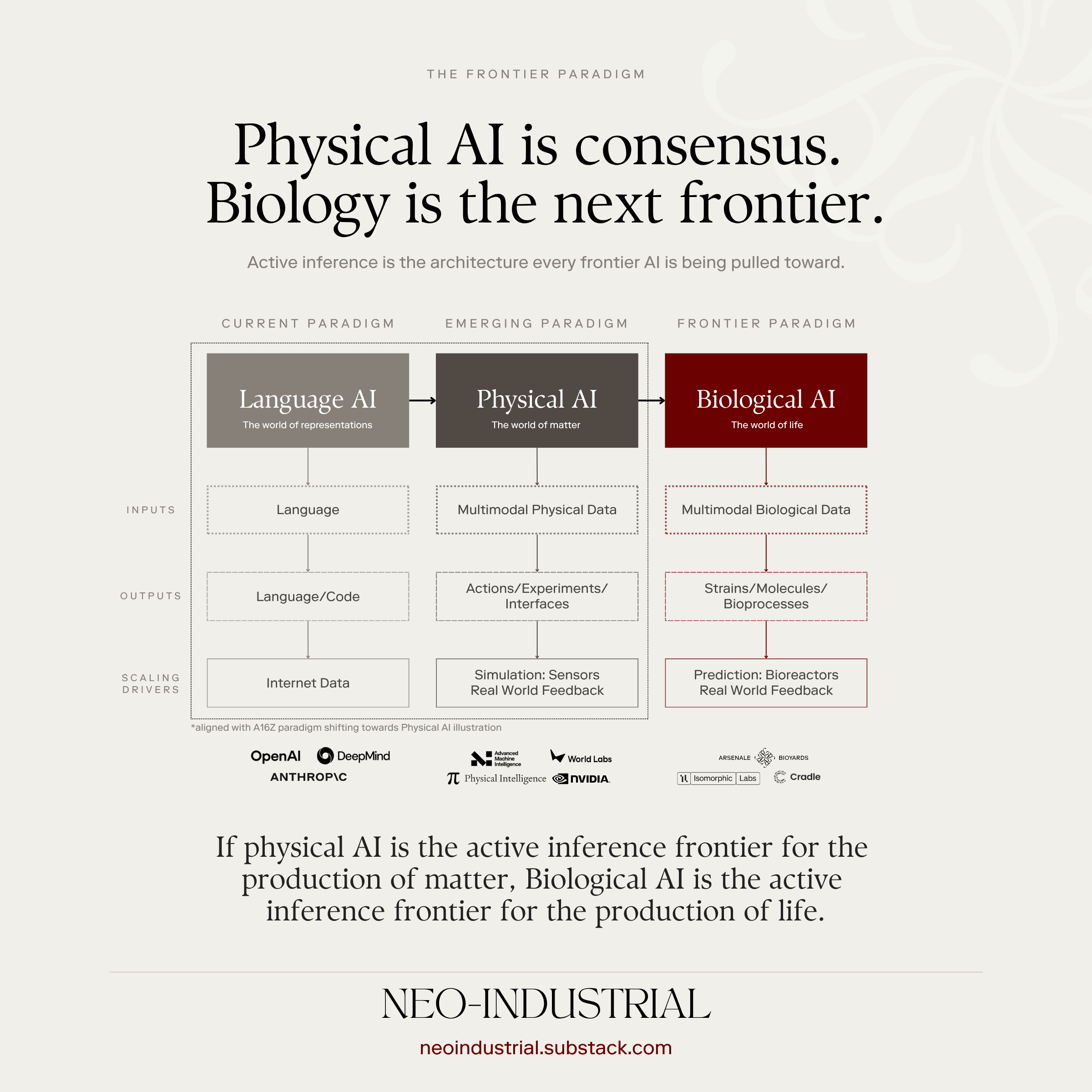
Physical AI addresses systems governed by well-understood physics. Biological systems are different in kind: theoretically underspecified, populated by adaptive agents, nested across multiple timescales. Biological AI is the harder frontier, and the one Arsenale is being forced to build.
There is a frontier beyond Physical AI that is harder, less discussed, and more consequential for what Arsenale is building.
Physical AI, in its current form, addresses systems that are largely mechanistic. The dynamics of a robot arm, a vehicle, a fab tool, a power grid, even a battery cell, are governed by physics that is well understood and, for the most part, computationally tractable. The world model can be quite accurate, because the world it models is, fundamentally, the one that Newton, Maxwell, and the engineers of the twentieth century already mapped. Physical AI is hard because the systems are large and the data is messy, but the underlying physics is not in question.
Biological systems are different in kind. A precision fermentation process running at industrial scale is not a mechanistic system. It is a population of living cells responding adaptively to conditions, evolving on the timescale of the run, producing emergent dynamics that no first-principles model can fully capture. The behaviour of a microbial population in a hundred-thousand-litre bioreactor is not a problem of computational scale. It is a problem of theoretical underspecification. We do not have, and may never have, a complete physics of cellular metabolism. What we have are partial models, statistical regularities, and a great deal of operational know-how.
For a Neo-Industrial Company operating in this domain, the active inference frame has to extend further. The generative model cannot be primarily simulative, because we cannot simulate the system being modelled from first principles. It must be primarily predictive, in a stronger sense: capable of forecasting emergent behaviour from limited theoretical scaffolding plus high-resolution operational data, and capable of acting to keep the process inside a viable envelope even when the underlying dynamics are not fully understood.
This is what we would call Biological AI, and it is the frontier where Arsenale lies, by necessity rather than by choice, working to build it. It differs from Physical AI in three specific ways.
First, the generative model has to navigate scenarios with significantly more stochasticity and irreducible uncertainty than the average Physical AI application. This is not because biology is messier than physics in some philosophical sense. It is because we know less about biology, our theoretical models are more incomplete, and the dynamics we are trying to predict are populated by adaptive agents whose state space is only partially observable. The Digital Original, in this context, has to be built to operate under that irreducible uncertainty, rather than to converge on a deterministic answer. The Calibration Imperative becomes even more central, because the model has fewer first-principle anchors and depends more heavily on continuous correspondence with the operating Real Twin.
Second, the action policy must accommodate biological agency. The cells in a fermentation process are not passive substrate. They are themselves adaptive agents, evolving, responding, sometimes contesting the conditions imposed on them. A control policy that ignores this and treats biology as if it were chemistry produces the failure modes that have plagued precision fermentation for two decades. A control policy that treats biology as biology, as an active inference system in its own right interacting with the company’s active inference system, is a different kind of operating logic. It sits at the intersection of ecology and engineering.
Third, the time horizons of inference are nested in a way that physical systems usually do not require. There is the timescale of cellular metabolism, the timescale of population dynamics, the timescale of strain drift across batches, and the timescale of process evolution across campaigns. Each timescale has its own generative model, its own prediction errors, and its own action policy. The Neo-Industrial Company in this domain is, in effect, running multiple inference loops at different tempos, all coupled, none reducible to the others.
If Physical AI is the active inference frontier for the production of matter, Biological AI is the active inference frontier for the production of life. The principles are the same. The substrate is harder. The prize, in industries from materials to food to therapeutics, is significantly larger. And the organizational form capable of building these systems is, again, the Neo-Industrial Company. The Generative Phenotype is substrate-agnostic, which is part of what makes it a useful frame.
“If Physical AI is the active inference frontier for the production of matter, Biological AI is the active inference frontier for the production of life.”
The Critical Conversation
The most serious objection to active inference comes from inside the field itself: that the framework, in its strongest formulation, may be unfalsifiable. We take the critique seriously, but we use the framework as a design language, not as an empirical claim about how brains literally function.
At this point, an honest reader will have an important objection to the framework as we have presented it, and we want to take it seriously rather than wave it off. The objection comes from inside the active inference literature itself. The framework has serious critics. Bruineberg, Dolega, Dewhurst and colleagues, in their 2021 Behavioral and Brain Sciences paper "The Emperor's New Markov Blankets", argue that the free energy principle, in its strongest formulations, may be unfalsifiable. If any persistent system can be described, after the fact, as minimising free energy under some generative model, then the framework explains everything and predicts nothing. It becomes what philosophers of science call a metaphysical research program rather than an empirical theory. A second strand of critique, well surveyed by van Es and Hipolito (2022), is that active inference is one frame among several, and its theoretical reach exceeds its empirical track record.
We take these critiques seriously. We do not want this essay to read as if active inference were settled science. But the critiques cut less than they appear to when the framework is used as we are using it here, which is as a design language rather than as an empirical claim about how brains and organizations literally function. The question is not whether the human brain provably minimises free energy. The question is whether the architectural principles drawn from active inference produce organizations that behave like inference machines in the sense that matters. Those principles are: keeping a clean separation between the channels through which the world feeds the model (sensors) and the channels through which the model acts on the world (actuators); maintaining a generative model that predicts rather than merely describes; anchoring that model to ground truth; and treating prediction error as the most informative signal. Together, they produce organizations that learn faster, act more effectively, and maintain coherence with reality over time. The empirical case for that, in our experience building Arsenale and watching the broader Neo-Industrial cohort, is strong, regardless of whether Friston's deepest claims about the brain hold up.
There is a useful precedent. Cybernetics, in the 1940s and 1950s, made grand theoretical claims that were eventually refined, contested, and partially absorbed. The strong cybernetic program failed. The design language survived, and shaped everything from control engineering to systems biology to AI safety. Active inference may, or may not, follow a similar trajectory. Whether or not it is the unified theory of mind that Friston believes it to be, it is, today, the most coherent design language available for organizations that perceive, predict, and act in tightly coupled loops with their environments. That is what the Neo-Industrial Company is. That is what makes the framework useful.
Why Now?
The architecture this essay describes draws on ideas that have been around for decades. What is genuinely new in 2026 is that perception, reasoning, and the closed loop are finally working at the same time. That convergence is what makes Neo-Industrial Companies buildable now in a way they were not even five years ago.
The architecture this essay describes draws on ideas that have been around for decades. The question is why it is becoming buildable only now.
What has actually happened over the last forty years, viewed honestly, is a series of consistent evolutions rather than opposing camps. Neural networks in the 1980s and 1990s were not formally wrong. They failed in practical settings because the compute and data could not yet support them. The community moved toward Bayesian modelling and kernel methods because, at the time, those approaches squeezed more out of less data and less compute. When compute and data caught up in the 2010s, neural networks succeeded in computer vision, and then again in language. The same pattern is now repeating with reasoning agents. Each of these waves has looked like a paradigm shift in the moment, and a continuous evolution in retrospect.
The deeper division, the one that matters here, is functional rather than factional. Bayesian methods and their relatives are excellent formalisms for reasoning. Neural networks are excellent at perception. Neither, on its own, can situate an agent in the world. To do that, three things are needed at once: a way to perceive (deep learning, in our era), a way to reason (a world model, an action policy, some structured representation of cause and effect), and a framework to wire them together (call it RL, call it active inference, call it whatever you prefer). What is genuinely new in 2026 is that all three are finally working at the same time. Perception, after a long stretch of being the bottleneck, has become reliable enough to support reasoning agents in real environments. Physical AI is emerging because that combination has finally become buildable.
This convergence is what makes the Neo-Industrial Company possible now in a way it was not even five years ago. Arsenale, and the Neo-Industrial cohort more broadly, are now building exactly this: the organizational form that integrates perception, reasoning, and the closed loop into a single industrial architecture. That is what active inference gives us as a design language. That is what Physical AI gives us as a technical substrate. That is what the Neo-Industrial Company is built to operate.
The model and the world have to remain in correspondence, and the only way to keep them in correspondence is to act, to fail, to update, and to act again. There is no shortcut. There is only the loop.
“There is no short cut. There is only the loop.”
What This Changes
Once the Neo-Industrial Company is understood as an inference machine, the diagnostic for investors sharpens, the design discipline for operators clarifies, and the policy questions for Europe become specific. The pillars we have named across this series are not a list of features but components of a single architecture.
Once the Neo-Industrial Company is understood as an inference machine, several things that have looked like separate strategic choices reveal themselves as components of a single architecture, and the implications become sharper for everyone in the ecosystem.
For investors, the diagnostic becomes more discriminating. A Neo-Industrial Company can be evaluated by the integrity of its inference loop. Does it use its generative model in a predictive or merely descriptive way? Is the model anchored to ground truth through a working learning loop? Is prediction error allowed to reach and update the model, or is it suppressed by procedural orthodoxy? Can the company transfer the learnings across relevant scales in a reliable way? These questions are more revealing than the conventional checklist of technology, team, and market, and they map directly onto the failure modes that have defined a generation of failed deep tech ventures.
For operators, the implication is that the architecture has to be designed as an inference system from inception. The temptation to bolt on data infrastructure later, or to treat the Digital Original as a rendering rather than a generative model, or to defer the calibration mechanism until the plant is running, is the temptation to break the loop before it has had a chance to close. Architecture is not a feature that can be added. It is the substrate that determines what features become possible. An inference machine that is not built as one from day one is unlikely to become one later.
For policymakers, particularly in Europe, the strategic question becomes whether national industrial policy is creating the conditions for inference machines to be built at scale, or whether it is, by default, recreating the conditions for the next generation of incumbents. Capital structures that fund equity but not asset-backed production financing, regulatory regimes that suppress operational data sharing, education systems that separate AI from manufacturing: these are policies that break the active inference loop at specific points. They are also, not coincidentally, the policies that have contributed to Europe’s industrial transfer gap.
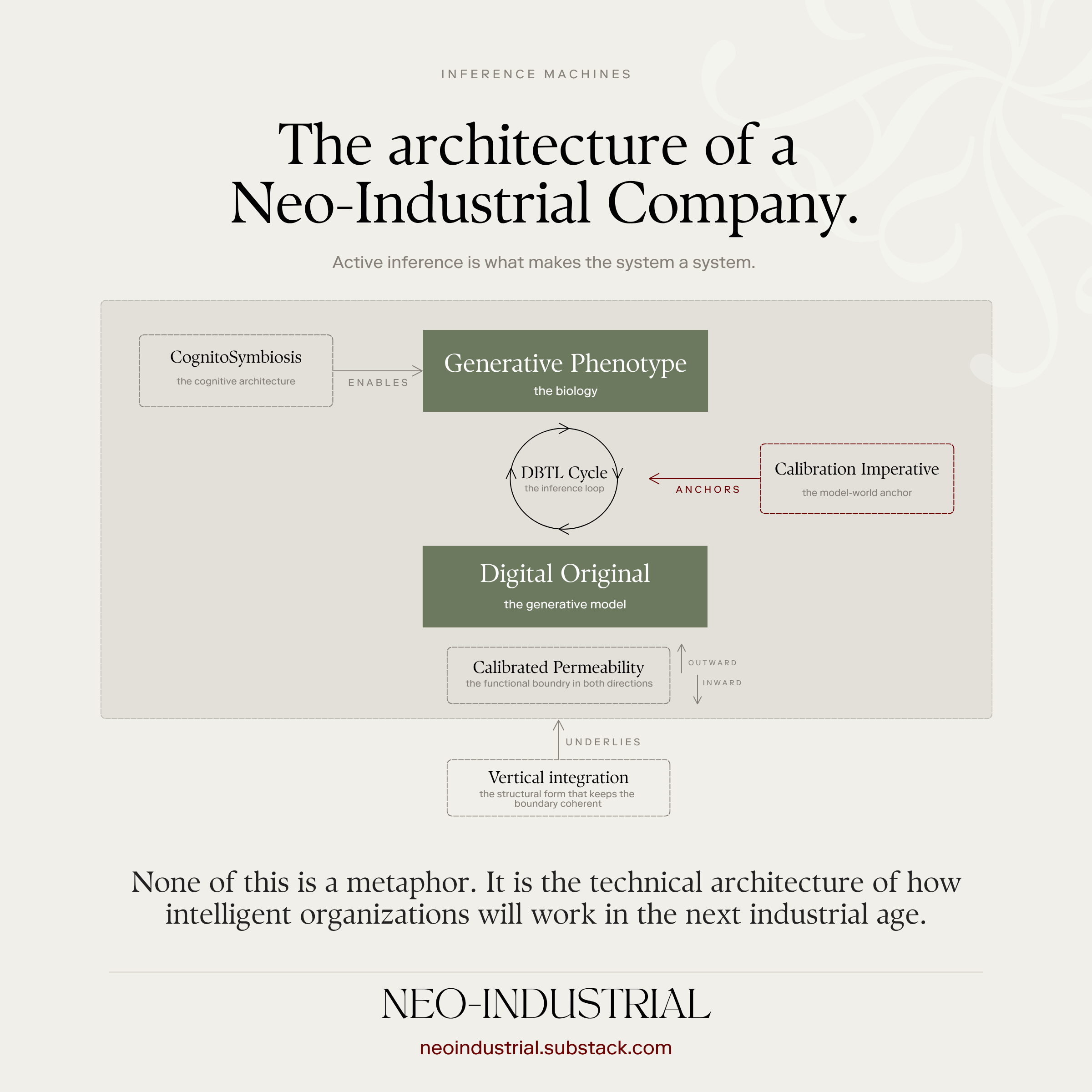
The Neo-Industrial Company is, at its core, an inference machine. The Generative Phenotype is its biology. The Digital Original is its generative model. The DBTL cycle is its inference loop. CognitoSymbiosis is the cognitive architecture that gives it the processing capacity to absorb the world without fragmenting. Calibrated Permeability is what keeps its boundary functional in both directions. Vertical integration is what keeps that permeability coherent in an immature industrial domain. The Calibration Imperative is what keeps the model anchored to the world it claims to predict. None of this is metaphor. It is, increasingly, the technical architecture of how intelligent organizations will work in the next industrial age.
Physical AI is the frontier of how machines reason about matter. Biological AI is the frontier of how machines reason about life. Both will be built inside Neo-Industrial Companies, because no other organizational form is configured to close the inference loop between intelligence and industrial reality. That is what the next decade is going to be about, and it is what Arsenale, along with a small but growing cohort of Neo-Industrial builders, is working to make real.
The companies that succeed will not be the ones with the best models. They will be the ones whose models, sensors, actions, and capital are wired into a single inference loop, running at clockspeed, anchored to the world, powered by the data they generate. They will be inference machines. And the world, whether it knows it yet or not, is about to be rebuilt by them.
“The companies that succeed will not be the ones with the best models. They will be the ones whose models, sensors, actions, and capital are wired into a single inference loop.”
There is a deeper reason action matters here, beyond the intuitive distinction between watching and intervening. Purely observational inference, however large the dataset, cannot attribute causality, only correlation. It is action, the deliberate intervention on a system to see what changes downstream, that lets a learning system separate causal structure from coincidence. The bioreactor that adjusts feed rate and observes the response is doing something the weather model fundamentally cannot. It is asking causal questions of the world. This is one of the deepest reasons why industrial intelligence cannot be a corpus problem. Causality only emerges through action.
There may be more failure modes. For instance - learning from environmental conditions that aren’t representative of reality’s variance for too long just because they’re easier to model. In this essay we focus on the ones linked to the architecture
A useful frame for what this architecture, viewed from the user’s side, actually is, comes from the Arena Physica essay: a Compiler for Atoms. Software compilers translate progressively higher-level intent into machine instructions, and LLMs are now compiling English into code. Physics has had no such compiler. Until recently, accessing the universe’s instruction set required hiring the equivalent of an assembly-language programmer, a physicist who has spent decades learning to translate human intent into materials and geometries. A foundation model for fields, embedded in an organization that can fabricate and validate, becomes the higher-level language. State what you want, and the system compiles down into the geometries and materials that produce it. The Compiler for Atoms is, in active inference terms, the point at which the generative model becomes powerful enough to invert. The question shifts from “what does this configuration produce?” to “what configuration produces this?” Generative design replaces analytical design. Across Physical AI and Biological AI, this is the same transition. The Neo-Industrial Company is the organization that operates this compiler at industrial scale.
One observation from the Arena Physica essay is worth flagging on its own. The shapes Arena Physica's model produces, when fabricated, often look nothing like what a human RF engineer would have drawn: stippled patterns, QR-code-like geometries, structures that violate canonical textbook intuitions and yet outperform them. The authors draw the parallel to AlphaGo's Move 37, the move expert commentators first dismissed as a mistake before recognising it as superior to anything humans had found in two thousand years of play. The point generalises. A learning system that is allowed to develop its own representations of a domain, rather than have human-shaped intuitions baked in, will at the limit produce solutions no human would have proposed. This is, in essence, what Sutton's Bitter Lesson was pointing at, and the Generative Phenotype, as I argued in the second essay of this series, is the organizational form that admits such solutions into reality rather than rejecting them as anomalies. Inference machines do not merely accelerate human design. At their best they produce what human design could not have produced.
A big thank you goes to Gianni Giacomelli, Jonas Moeller and Riccardo Volpi for their input on the draft, and to Nicole Laurence and Claude for the editing
Notes and sources
Active inference, the free energy principle, and predictive coding draw on a substantial literature. The most accessible introductions are Karl Friston, “The free-energy principle: a unified brain theory?” Nature Reviews Neuroscience 11 (2010); Andy Clark, Surfing Uncertainty (2016); and Anil Seth, Being You (2021). The critical literature includes Bruineberg, Dolega, Dewhurst and Baltieri, “The Emperor’s New Markov Blankets,” Behavioral and Brain Sciences (2021), and a useful survey in van Es and Hipolito, “Searching for the Free Energy Principle” (2022). Gary Marcus’s book Rebooting AI (with Ernest Davis, 2019) and his ongoing essays at Marcus on AI lay out the structural critique of pure scaling. The “Bitter Lesson” is from Rich Sutton’s 2019 essay of the same name. Its actual argument is that learning systems should be designed to learn rather than have human-shaped structure baked in: methods that absorb computation and data have consistently outperformed methods that pre-encode researchers’ intuitions about how an agent should think. The examples Sutton uses, DeepBlue and AlphaGo, are systems that act in their environment, observe outcomes, and update, which is structurally consistent with the active inference frame this essay relies on.
Oliver Hsu’s two essays at Andreessen Horowitz, “The Physical AI Deployment Gap” (January 2026) and “Frontier Systems for the Physical World” (April 2026), are the clearest articulation we have read of what the deployment gap actually consists of and what primitives are being built to close it. The 95-versus-99.9 reliability framing, the compounding failure modes argument, the data flywheel argument, and the five-primitives framing all draw on Hsu’s work, and the present essay is sharper for engaging with it.
The two operational counterparts that anchor much of this essay are Packy McCormick and Evan Beard, “Many Small Steps for Robot, One Giant Leap for Mankind” (Not Boring, 2026), and Packy McCormick and Pratap Ranade, “Electromagnetism Secretly Runs the World” (Not Boring, 2026). The first is the source for the Standard Bots example and for the “climbing the gradient of variability” framing. The second is the source for the Arena Physica example, the Compiler for Atoms framing, and the speed-versus-precision insight in the explore/exploit section. McCormick’s “Take Weird Ideas Seriously” makes the broader argument that the AI race is currently in an exploit phase climbing a local maximum. On Physical AI and world models, Yann LeCun’s JEPA papers and Demis Hassabis’s recent talks on generative world models are the most direct references, and NVIDIA’s Cosmos and World Foundation Model platform documentation provides the industrial context. The Biological AI framing is, to our knowledge, Arsenale’s own, drawn from operational experience at Arsenale, and we welcome engagement from anyone working on the same frontier.
This is a great essay and probably five essays in one. One question that immediately comes to mind is what kind of education will we need to provide to the next generation of managers and leaders. Clearly the current discipline-based education doesn’t give people the tools to design the organizations of the future if we assume for a second that active inference based organizations will be the future.